
Materials
Open /dashboard/assets/materialsA material is what makes a colour look like fabric instead of paint. It controls how light behaves on the surface: whether it is matte or shiny, smooth or woven, flat or textured. Two garments in the same colour can look completely different depending on the material.
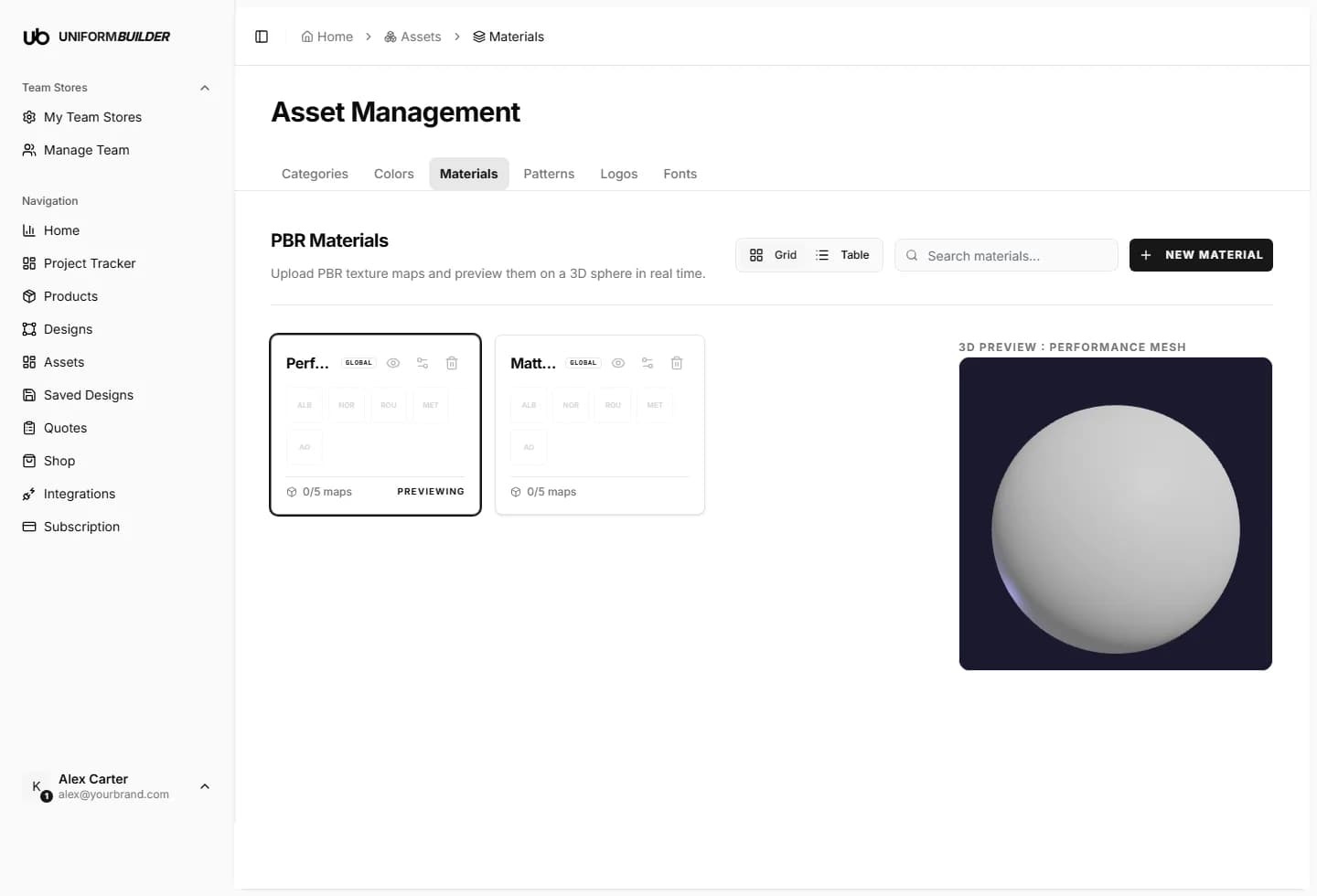
What a PBR material is made of
PBR stands for physically based rendering. In plain terms: instead of guessing, the 3D viewer is given a few greyscale and colour images that describe the surface, and it works out the shading from them. Those images are called maps. You can link up to five.
The five maps
| Field | What it does |
|---|---|
| Albedo | The plain colour of the surface with no lighting baked in. This is the only map most fabrics really need. Think of it as a flat scan of the cloth. |
| Normal | Fakes bumps and weave without adding geometry. It is the map that makes a mesh look like actual mesh rather than a printed picture of one. Normal maps look mostly lilac blue: that is correct. |
| Roughness | Greyscale. Black is mirror shiny, white is completely matte. This is what separates satin from cotton. |
| Metalness | Greyscale. Black for anything non-metal, white for bare metal. Fabric is almost always black here, so you can usually leave it empty. |
| AO | Ambient occlusion. Darkens the crevices where light would not reach, for example between the threads of a heavy knit. Optional, and subtle. |
You do not need all five
Albedo alone gives a usable material. Add roughness next, then normal. Metalness and AO are refinements for when you want a specific fabric to look exactly right.
Creating a material, step by step
- 1
Click New Material in the top right of the Materials tab.
If your library is empty, the Add First Material button in the middle of the page does the same thing.
- 2
Type a material name. This field is required.
Name it the way you talk about it in the workshop: "Performance Mesh", "Matte Jersey Knit". Customers may see this name when choosing a fabric.
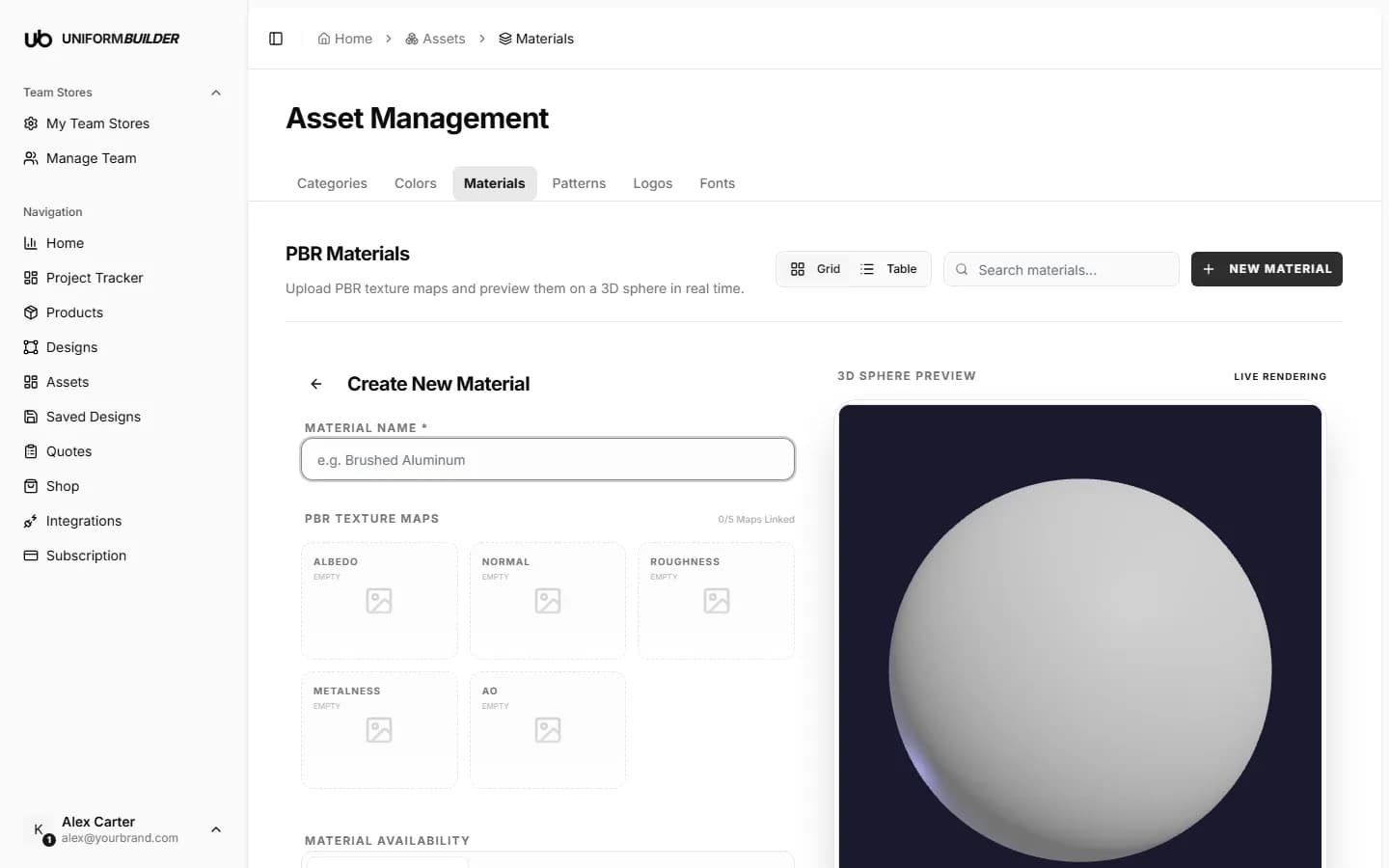
The form. On the right, a sphere renders your material live as you link maps. - 3
Upload your maps into the slots.
Each slot shows EMPTY with an UPLOAD button. Click it and choose an image file. The counter at the top reads "0/5 Maps Linked" and goes up as you add them.
- 4
Watch the 3D sphere preview on the right.
It re-renders as soon as a map finishes uploading. This is the fastest way to tell whether a roughness map is too dark or a normal map is inverted.
- 5
Set Material availability: Global, By category, or Products.
Same rule as everywhere else. A mesh belongs on jerseys, not on a hoodie. See the Assign to rule.
- 6
Click Create Material.
Where the map images come from
- Your fabric supplier may already have scans. Ask: it is a normal request.
- A flat, evenly lit photograph of the fabric, cropped square, works as an albedo map.
- Texture libraries sell ready made PBR fabric sets that include all the maps at once.
- Whoever makes your 3D models can usually export the maps from the same source.
Maps must tile
These images repeat across the garment. If the left edge does not line up with the right edge, you will see a visible grid on the 3D preview. A tileable texture is one that has been prepared to wrap seamlessly.
Do not bake shadows into the albedo
If your fabric photo has a shadow across it, that shadow will be printed onto every garment in the viewer, from every angle. Use an evenly lit photo.
Editing and removing
The pencil on a material card reopens the same form so you can swap a map or change availability. The bin deletes it.
Note
Deleting a material stops it being offered to new customers. Designs already saved keep the look they were saved with.
My material looks flat and plastic.
That is usually the roughness map. With no roughness map, everything renders at a default shine. Add one, and make it light grey to near white for most fabrics.
The weave looks like it is carved inwards, not raised.
The normal map is inverted. Re-export it with the green channel flipped, or ask whoever made it for the other convention.
Do I need a material at all?
No. Products render perfectly well without one. Materials are how you go from "a coloured shape" to "that looks like our fabric", which matters more the closer your customer looks.